Painted Streets, Borrowed Rooms: A Short History of Screen Sets
Screen sets have evolved from painted backdrops into flexible story spaces, helping filmmakers shape streets and rooms around the camera and action.
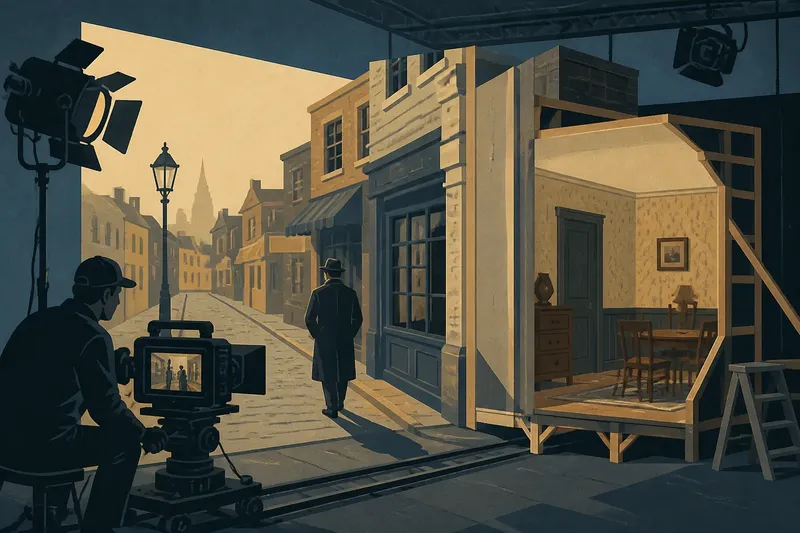
The common mistake about screen sets is to call them cheap copies of real places. That misses both their history and their purpose: a built street or room lets a production shape the view, movement, and atmosphere around a scene. Screen sets have changed with filmmaking, but the basic idea has endured: build only the world the story needs to show.
That history is not a straight march from artificial scenery to realism. Stagecraft, camera technology, and production needs have continually changed what a set can do, from suggesting a place with a painted backdrop to giving performers and crews a room they can work inside.
Early stage illusions
Early filmmakers borrowed from theater, where painted backdrops and movable flats could suggest streets, parlors, or grand halls. The camera offered a useful limit: a wall did not need to exist beyond the frame, and a doorway could be placed where the audience would read it as part of a believable room.
These early arrangements made travel unnecessary for scenes that could be staged in a controlled space. They also made the image a kind of composition. A designer could place a window, piece of furniture, or painted skyline exactly where the camera needed it, rather than accept the arrangement of an existing location.
Studios shape the image
As studio filmmaking developed, sets became working environments rather than fixed theatrical pictures. Walls could be built to move aside, ceilings left open for lighting, and doorways widened for equipment. The finished frame concealed those accommodations while the set served actors, cameras, and crew.
Repeatability mattered as well. A scene might be filmed in separate pieces, with the camera and lights repositioned between shots. A controlled set made it easier to return to a similar arrangement and keep actors away from changing traffic or access conditions. Like a dress form in a tailor’s shop, the stage offered a stable shape around which a particular image could be fitted.
Streets made for framing
A real street arrives with details a production may not want: signs, parked cars, passersby, modern windows, and buildings that do not fit the story’s period or geography. A constructed street can include the details needed for the camera while leaving out distractions.
Some street sets have solid, usable foregrounds and more compressed scenery in the distance. Forced perspective, painted surfaces, and extensions can suggest a longer road or a larger district. The aim is not necessarily to build an entire city block; it is to make the visible parts read as one place.
Say a production needs a narrow market lane for a story set in an old district, but its available street is wide and lined with modern shops. The designers build a short section with close façades, period-style shop fronts, and a corner for the actor to turn behind. The expected result is a tighter frame that suggests an enclosed lane, while the crew can repeat the movement without clearing a public road.
Rooms built for cameras
Real homes are arranged for living, not filming. A kitchen’s best wall for a conversation may leave no good camera position; a bedroom may have little room for lights or a moving camera. A set can keep the recognizable logic of a home while changing its openings and proportions to serve the scene.
Removable walls let a camera occupy space that would ordinarily be blocked. A partial ceiling or wider corridor can give the crew access while preserving the impression of a complete interior in the finished shot. Sets can also connect rooms in a useful order, keeping an actor’s movement visible even when the equivalent spaces in a real house would be separated or cramped.
Light and weather
Outdoor locations offer real sunlight and weather, but neither follows a shooting schedule. Clouds can alter a scene’s look between takes, and rain may arrive at the wrong time. A stage gives the crew more control over the conditions shaping the image.
Lighting can suggest daylight, moonlight, or an overcast afternoon, while the art department coordinates paint colors and surface finishes with that plan. A night street built on a stage may be easier to darken and light selectively than a real neighborhood with active businesses and unrelated sources of light.
Control alone does not make a set convincing. Even lighting, spotless surfaces, or a street with no visual depth can reveal the construction. Credibility comes from the way details, light, and framing work together to suggest a place beyond what the camera shows.
Changing production needs
Sets have continued to adapt as production methods have changed. Some scenes combine location footage with stage-built interiors; others use a partial exterior or a room designed to accommodate specialized camera movement. Construction can also help when a real building is difficult to access, disruptive to use, or unable to accommodate the required action.
A built environment may make room for a moving platform or controlled collapse, while protecting a delicate location from repeated foot traffic and equipment. The choice is not always between a real place and an artificial one. A film can borrow the texture of an actual exterior and use a constructed interior for the scene that needs more control.
What makes a set convincing?
Why build a set instead of filming on location?
A set can give the crew control over layout, access, light, and repeated movement. A location offers its own textures and activity, but existing features may limit the camera positions or action the scene needs.
How can a small set suggest a larger world?
Designers concentrate detail where the camera will look, then use framing, perspective, or extensions to imply space beyond it. The audience needs a coherent impression, not a complete building visible from every angle.
Can a set affect an actor’s movement?
A set can provide clear paths, usable doors, and room to play a scene without fighting the location’s layout. Its scale and surfaces still need to feel plausible enough that movement does not draw attention to the construction.
When is a real location the better choice?
A location may suit a scene when its texture, scale, or surrounding activity is central and difficult to recreate. The production also needs to consider access and whether the required camera positions are possible there.
Choosing the right place
A stage-built world is not automatically better than a real one. If a story depends on the irregular shape of an actual room or the bustle around a real street, construction may smooth away qualities that make the setting feel particular. A location, in turn, may impose visual compromises that distract from the action.
The most persuasive choice may combine methods: a real exterior for its depth, a built interior for camera access, and a visual plan that makes the transition feel continuous. Screen sets have endured because they let filmmakers compose a setting rather than simply visit one. To understand why a place feels right on screen, notice how its layout serves the action as much as its decorative detail.